The Bedtime Phone Battle Can't Be Won at Bedtime
 By Hank Yang. Harvard Divinity School, MTS '26 · Founder of PhonePact · Built internet businesses reaching millionsUpdated July 2026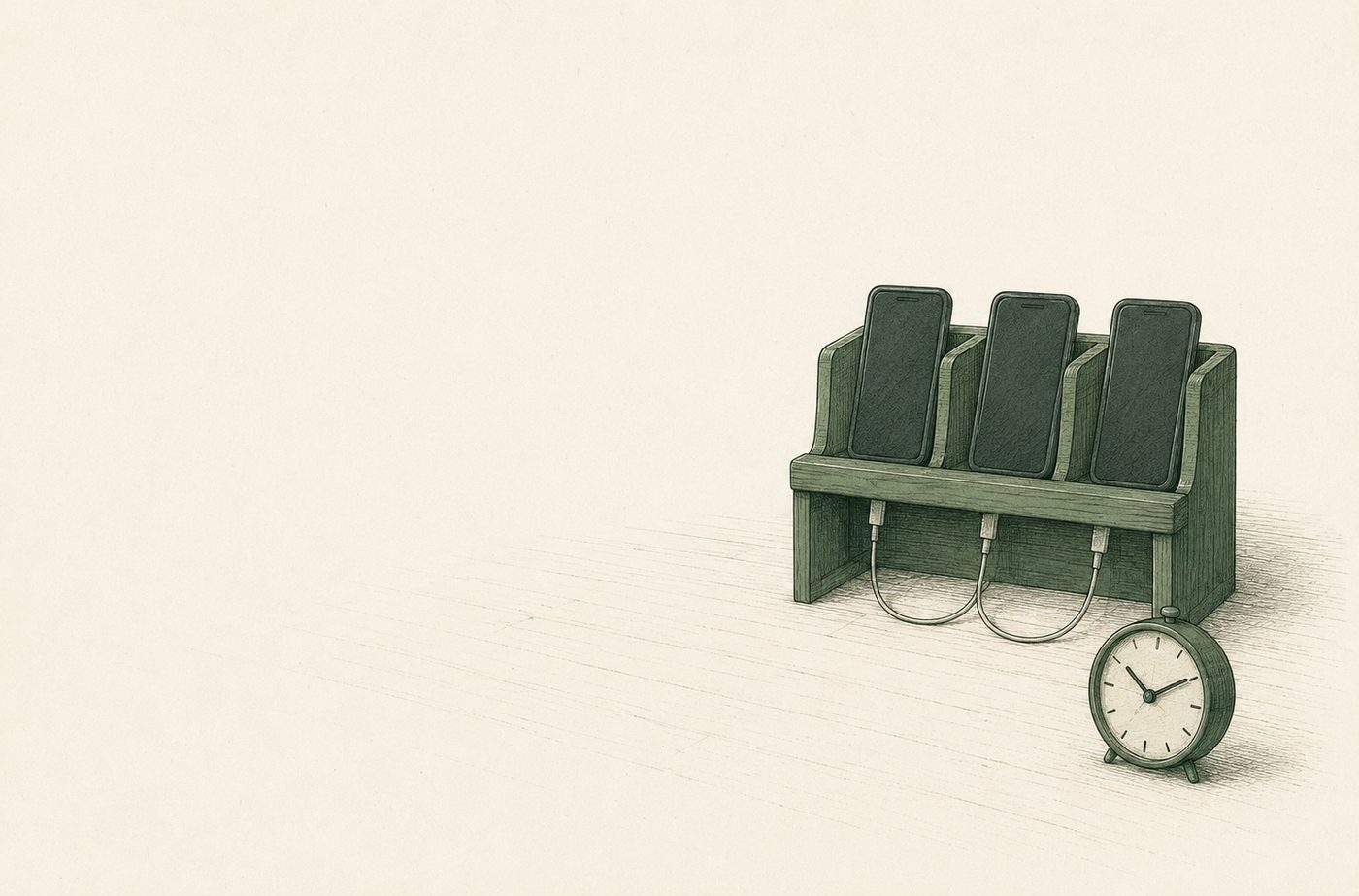
The short answer: you can't win the bedtime phone battle with arguments, because at 10pm you're negotiating with the tiredest, most impulsive version of your child against apps engineered to serve one more thing forever. You win it structurally, once: phones sleep outside all bedrooms, everyone's, on a family charger, with the decision made in daylight. Then there's nothing left to argue about at night.
The nightly sequence is the same in millions of houses. Lights out was 9:30. At 10:15 there's a glow under the door. Confrontation, negotiation, "one more minute," repeat tomorrow. Here's why it keeps happening and the one change that actually ends it.
Why is my kid's phone use worst at bedtime?
Four forces stack at night, and knowing them matters because it moves you from "my kid is defiant" to "my kid is outmatched," which is both kinder and more accurate.
Self-control is empty. Willpower behaves like a resource that depletes across the day, for kids doubly so after a full shift of school, rules, and holding it together. Bedtime demands one more act of discipline at the hour the tank reads zero.
The feed never ends on purpose. Autoplay, infinite scroll, and streaks are engineered so that no natural stopping point ever arrives. Your child isn't failing to find the end. There isn't one.
Bed is where the day's feelings surface. The quiet dark is when social worries and school dread get loud, and the phone mutes all of it instantly. For plenty of kids, bedtime scrolling isn't entertainment, it's anesthesia, which is why "just put it down" misses.
And the room is private. Nobody sees the 11pm scroll, so it costs nothing. Behavior that's invisible and free repeats.
The cost is mostly paid in sleep, and sleep is the load-bearing wall: short sleep in kids and teens degrades mood, attention, and impulse control the next day, which makes the next bedtime harder, which is the spiral. Pediatric sleep guidance is unambiguous that screens out of the bedroom is the single most protective move available.
What actually works: the family charging station
One spot, everyone's phones, every night. A charger in the kitchen or hallway. Phones land there at a set time, parents' included, and that last clause is not decoration. If only the kid's phone sleeps in the kitchen, it's a punishment and gets appealed nightly. If everyone's does, it's a household custom, like where the shoes go, and customs enforce themselves. Expect your own withdrawal to be instructive.
Decide the details in daylight. Landing time, exceptions, all of it agreed at a calm family moment, ideally written into your family screen agreement. The whole point is that nighttime enforcement conversations stop existing. There's no negotiation at 10pm because there's nothing to negotiate; the decision was made at 4pm by better versions of everyone.
Know what you're actually protecting. The mechanisms by which phones steal teen sleep, and which one matters least, are in our screens and sleep guide.
Buy alarm clocks. "I need it for my alarm" is the load-bearing objection and it dies for fifteen dollars. Handle it before it's raised.
Build a runway, not a cliff. The phone landing shouldn't be the last event before lights out; that's a stimulation cliff, and for ADHD kids especially, cliffs mean meltdowns. Thirty to sixty minutes between the charger and sleep, with something in the gap: shower, snack, a paper book, music on a speaker. The gap is where the day's feelings surface, and for younger kids it's quietly the best conversational window of the day. Don't waste it on enforcement energy.
Expect a rough ten days. You're removing a sleep aid, or so it feels to a kid whose phone was managing bedtime anxiety. Nights one through ten can genuinely be harder before they're better. Hold the structure warmly, name what's happening ("your brain's used to the phone at night, it'll recalibrate"), and don't read the protest as proof it isn't working. The protest is the recalibration.
What if my teen is too old for a charging station?
For older teens, imposed structure starts costing more than it buys, and the goal shifts from enforcing the boundary to transferring it. Make it a pact instead of a rule: each of you sets your own phone-down time, and each receives the same narrow kind of duration signal rather than a detailed activity report. It preserves the mechanism (the scroll is no longer invisible or free) while granting the autonomy adolescence requires. Teens who'd tunnel under a rule will often hold a goal they authored, especially one their parent is visibly sweating too.
That mutual version is precisely what we built PhonePact for: self-chosen points and duration-only check-ins the family circle can receive when the app syncs pact points and later milestones, with nothing blocked. And if the 1am scroller in your house is actually you, that has its own article: revenge bedtime procrastination.
Questions people ask
What time should kids put their phones away at night?
Work back from the sleep their age needs (roughly 9 to 11 hours for school-age kids, 8 to 10 for teens) to a lights-out, then land phones 30 to 60 minutes before it. The buffer matters as much as the cutoff: it gives stimulation time to fall and feelings a place to surface besides the feed.
Should teenagers be allowed to keep phones in their room overnight?
The evidence points strongly to no bedroom phones at any age, but with older teens, impose less and negotiate more: a self-set phone-down time they share with you beats a rule they'll circumvent. The non-negotiable is protecting sleep; the method should grow up with the kid.
My child says they need their phone for their alarm. Now what?
An alarm clock costs less than one takeout dinner and removes the objection permanently. If music helps them sleep, a cheap speaker covers it without the feed attached.
How long until the bedtime battles actually stop?
Once the charging station is a settled custom, most families report the nightly fight simply disappearing within two to three weeks, because there's no decision left to fight about. The hard part is the first ten days and the parents' own compliance. Mostly the parents' own compliance.